How to Measure Your Website’s AI Traffic and Engagement
“How are we doing showing up in AI?”
If you haven’t gotten that question yet from your organization’s leadership, I’d be shocked.
Traffic from search engines is plummeting, and as AI tools take over, it’s natural to wonder when – or if – your organization’s website will regain some of those visitors.
Here are two reports you can use to measure how your website is performing in AI tools.
Google Search Console: Generative AI Features
One of the newest additions to Google Search Console, which for years has helped website owners share information about their sites with Google, is the “Generative AI Features” report.
The report, rolled out earlier this year, shows you the pages on your site that are appearing in Google’s AI overviews and Discover platform.
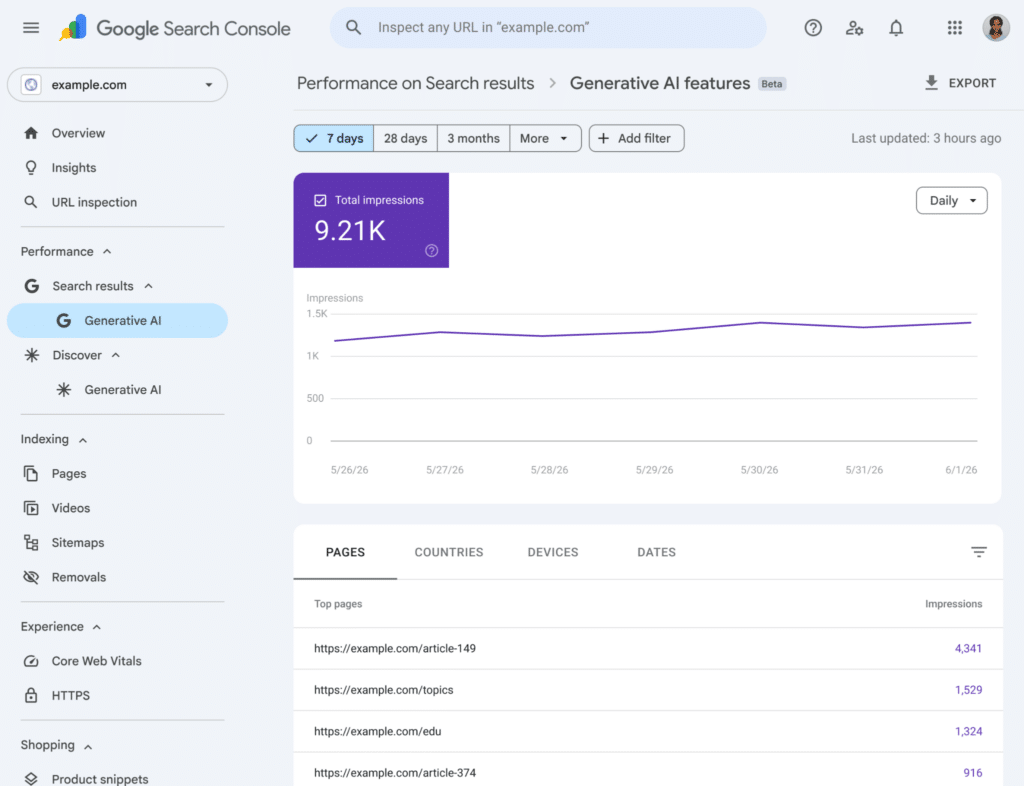
It breaks down the impressions by URL, country of the user, device of the user, and by date – so you can see exactly how many times your site was referenced each day. Reports allow you to choose date ranges, so you can review of the last day, week, month, or longer.
One thing to keep in mind: this is not a report of people who came to your website from AI tools. This is only a report of the content that appeared in AI results. So there’s no guarantee how many (if any) of these turned into website visitors.
The value in this report is showing the content on your site that is of interest to users, as well as confirming that you’re implementing AI best practices.
Google Analytics: AI Assistant Traffic
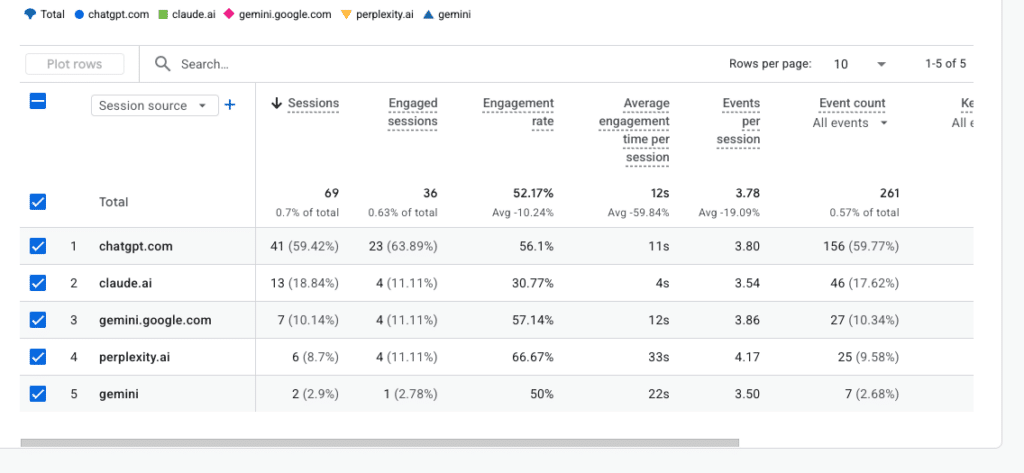
To get a measure of the actual traffic to your site from AI tools, Google Analytics breaks out “AI Assistant” as a source in its “Traffic Acquisition” report.
Head to the Acquisition -> Traffic acquisition report and look for “AI Assistant” as the source. (Not sure where this is? Ask the Google Analytics AI Advisor to give you a direct link.)
You can review the number of sessions, engaged sessions, engagement rate, and much more.
This is potentially the more impactful AI traffic report, since it shows how many people actually came to your site from AI tools. The list of sources are more likely names you’ve heard of – ChatGPT, Claude, Gemini, etc. And you can actually breakdown which AIs sent traffic to you; filter by “session source” and you’ll get a fuller list.
As we’ve discussed, the tactics used for generating website traffic have completely changed in the past year. The new optimal methods are still being developed, so nothing is completely set in stone yet.
It is important, however, to know that the days of focusing on “getting to the top of Google” are mostly gone – and never coming back. When the environment changes, so should we – and that’s what’s happening with the AI revolution.
Have questions about how your site is performing in AI? Reach out and let’s chat.
PS. Download our free report, AI and Nonprofit Websites: Today’s Best Practices, and make sure your site is optimized for AI today.