
What The Viral Dress Taught Us About Design

Remember the dress?
If you were on social media in 2015, I’m sure you know exactly what I’m talking about.
More than a decade ago, this photograph of a striped dress divided the Internet:
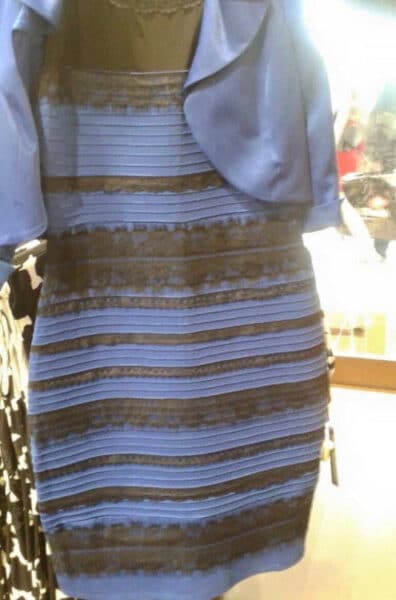
Some people saw it as white and gold, while others were convinced it was blue and black.
Families argued. Friends debated. Social media exploded.
More than ten years later, there is still an important lesson to be learned by this photo: we don’t just see with our eyes – we see with our brains.
Here’s the psychology behind the viral dress and what it means for designers and marketers.
Your Brain is Constantly Filling in the Blanks
When light reflects off an object, your eyes take in the information. At the same time, your brain is left to make sense of what it’s seeing, requiring it to fill in some gaps where needed.
Scientists call this color constancy, which is the brain’s ability to estimate lighting so that objects appear relatively consistent in color, regardless if you’re viewing them outdoors, indoors, in the shade, etc.
As Peter Bex, a vision scientist and psychology professor at Northeastern University, explains it:
“The apparent color of any object, including this dress, depends on both the material of the object and the light illuminating it. … In this photograph, however, viewers must estimate both the lighting and the dress color from the single image on screen.”
In other words, because the photograph of the dress contained unclear lighting and limited context, different people’s brains made different assumptions about it, which changed how the colors were perceived.
What This Means for Designers
“The dress” debate wasn’t really about color. It was about the perception.
The assumptions our brains make are based on our own past experiences and expectations.
The same concept goes beyond controversial clothing. Every design is interpreted through the lens of the person viewing it. That’s why two people can have completely different reactions to the exact same visual.
For this reason, it’s important to prioritize visual interest and clarity over anything else.
Design is Subjective, But Strategy Isn’t
One of the biggest misconceptions about design is that it’s entirely subjective.
While personal preferences will always exist, effective design is about clearly communicating a message, rather than focusing on what looks good to one person. A visitor should never have to guess where to click, what your organization does, or whether something is important.
Color plays a role in getting your message across, but a good design will also utilize things like contrast, visual hierarchy, and typography to eliminate the possibility of confusion or misinterpretation.
More than ten years later, “the dress” is still a fascinating reminder that perception isn’t always reality.
As marketers and designers, we can’t control how every individual will experience our work. What we can do is create designs that are clear, accessible, and intentional, reducing the need to fill in the blank wherever possible.
If your organization is ready to communicate without leaving room for interpretation, reach out to us – we’d love to help.